



The Sudanese National Library stands as a symbol of collective memory and one of the most vital instruments for restoring national consciousness through its intellectual space. It embodies the nation’s identity, history, and cultural heritage. The library, having been recovered after successive crises that preceded the outbreak of war, reaffirms today that culture can withstand all challenges when political will exists.
The disgraceful war that erupted on April 15, 2023, following the failed coup by the Rapid Support Forces militia and its local and regional supporters, did not only threaten the library’s physical structure but posed a real test for the state’s and civil society’s capacity to rise, protect the legacy of knowledge, reproduce national memory, and revive the spirit of scientific inquiry and enlightened thought.
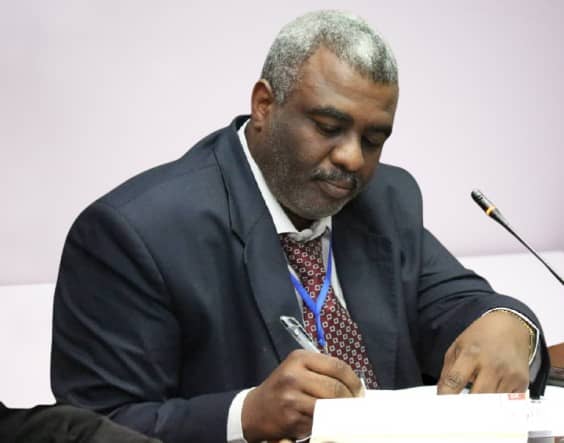
The visit of Khartoum State Governor, Mr. Ahmed Othman Hamza, yesterday to the National Library falls within this context, implicitly signaling a political will to rebuild the country’s cultural institutions. The governor emphasized the necessity of rehabilitating the library through coordination between the Ministry of Culture and Information at both state and federal levels, and the involvement of specialized experts to ensure the protection of books and references according to precise scientific standards. This would provide students and researchers with a vital space for academic inquiry. This step reflects an advanced understanding of culture’s role in preserving national identity and strengthening societal resilience.
Today, after confirming that the library’s contents remain intact despite the material damage to the building and equipment, the library stands as a central platform for unifying intellectual and educational efforts. Hence, reactivating the International Standard Book Number (ISBN) service must be a priority, for it signifies Sudan’s re-entry into the global publishing system and demonstrates a genuine recognition that protecting intellectual property and promoting scientific research are key to cultural revival and intellectual progress.
This approach enhances the library’s value as a reliable national reference for researchers and postgraduate students, asserting its strategic role as a hub for thought, creativity, and a bastion of Sudanese collective identity.
The dialectic of war and consciousness appears here clearly. While war attempted to erase the cultural heritage, the National Library has proven to be a safeguard for the nation’s history, enabling it to confront the present and envision the future. The intellectual resources it holds—historical texts, rare references, and scientific research—serve as a bridge connecting past and present, establishing a robust intellectual foundation capable of preserving Sudan’s historical and cultural heritage from obliteration and loss.
As an official and public information institution, the library carries out several national functions: collecting and preserving intellectual output, ensuring legal deposit, issuing national bibliographies, and coordinating library networks at both national and local levels. Thus, it symbolizes the state’s determination to uphold knowledge sovereignty as an inseparable part of national sovereignty.
In this regard, the role of intellectuals and researchers is crucial. They are called upon to actively participate in rebuilding collective memory by depositing rare manuscripts and scholarly works from their private libraries, thereby forming a broad knowledge base that supports national identity and enhances cultural dialogue with the world.
Here, a quote from the philosopher Jean-Jacques Rousseau takes on practical and existential dimensions. In his book The Social Contract, he states: “What makes a human being human is their ability to think, not to obey. Culture is not a luxury, but the soul of nations and their weapon against extinction.”
In this sense, the National Library is not merely a repository of documents but a symbol of cultural, political, and social will that protects the nation from fragmentation and reshapes national strength through knowledge and consciousness. It is an institutional space for intellectual resistance against destruction, a launching pad for research, education, and excellence initiatives, and a key reference for anyone seeking to understand Sudan’s present and future.
Therefore, the library’s recovery marks the beginning of the state’s regaining its ability to manage culture and knowledge—an essential factor during reconstruction periods. Transforming this effort into a comprehensive renaissance movement could fundamentally alter the relationship between society and its institutions, re-establishing the idea of the state as a guardian of knowledge rather than a censor. Reviving the National Library is a revival of Sudanese identity and a restoration of the human capital needed to lead the country toward a future built on knowledge rather than elite conflicts and erased memory.
According to #Face_of_Truth, restoring and activating the National Library’s services is a strategic step toward rebuilding the state from its cultural and intellectual roots. Between war and consciousness, the dialectic of contemporary Sudan takes shape, where knowledge becomes a tool for preserving identity and forging an enlightened future. The National Library is the heart of this project, embodying the nation’s collective will against oblivion and affirming that culture is not just shelves of books but the life, awareness, and living memory of a nation.
Best regards,
Monday, November 17, 2025
Shglawi55@gmail.com